
Audio Video Bridging (AVB TSN) is a suite of IEEE networking standards that enables high-quality, low-latency and time-synchronized audio and video streaming over Ethernet by adding deterministic behavior to conventional Ethernet networks.
It extends the IEEE 802.1Q VLAN framework to support time-sensitive traffic and is developed under the IEEE 802.1 working group, making it independent of any specific Ethernet PHY, though it is most commonly deployed over Ethernet.
AVB is promoted and supported by the AVnu Alliance to ensure interoperability across vendors. AVB is primarily implemented within Ethernet switches, which manage timing, bandwidth reservation and traffic prioritization but still referred to as “bridging” in IEEE terminology.
Together with Time-Sensitive Networking (TSN), AVB TSN operates mainly at Layer 2 (the Data Link Layer), enabling predictable and reliable delivery of audio and video streams for applications such as professional AV systems and in-vehicle infotainment networks.
AVB TSN is a flexible, open-standard technology that is widely accepted across industries for delivering reliable, time-sensitive audio and video over Ethernet networks. It can run on any Ethernet PHY, making it adaptable to a wide range of network speeds, media types, and application environments.
Table of Contents
Overview of AVB Functionality
Clock synchronization -> AVB TSN uses the Generalized Precision Time Protocol (gPTP) to synchronize all AVB devices to a common, highly accurate time reference.
Stream definition and bandwidth reservation -> The Stream Reservation Protocol (SRP) reserves required network resources end-to-end before a stream begins.
Traffic shaping -> Forwarding and Queuing Enhancements for Time-Sensitive Streams (FQTSS) prioritize AV traffic and control latency over best-effort Ethernet data.
Device discovery and management -> AVDECC enables automatic discovery, configuration and connection management of AVB-capable devices.
AV data transport -> Specialized Layer 2 and Layer 3 transport protocols carry audio and video streams with predictable timing and low latency.
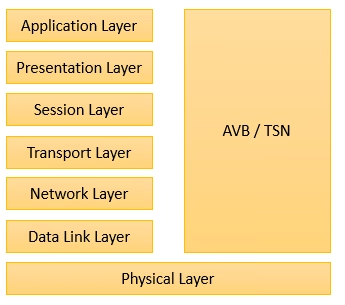
AVB TSN Standards
IEEE 802.1AB -> Defines the overall AVB TSN system architecture and how AVB components work together.
IEEE 802.1AS -> Specifies time synchronization using gPTP for time-sensitive applications in bridged Ethernet networks.
IEEE 802.1Qat -> Defines the Stream Reservation Protocol (SRP) for stream management and bandwidth reservation; it is now integrated into IEEE 802.1Q.
IEEE 802.1Qav -> Specifies Forwarding and Queuing Enhancements for Time-Sensitive Streams (FQTSS) for traffic shaping; it is also now part of IEEE 802.1Q.
IEEE 1722.1 -> It defines AVDECC (Audio Video Discovery, Enumeration, Connection Management and Control).
IEEE 1722 & IEEE 1733 -> Define Layer 2 and Layer 3 transport protocols for time-sensitive AV data; IEEE 1722 is commonly known as AVTP.
gPTP (Generalized Precision Time Protocol)
gPTP is used to precisely synchronize all participating devices so that audio and video streams can be delivered with consistent quality.
Its two primary responsibilities are to transmit clock synchronization information across the network and to measure propagation delays introduced by each Ethernet link and switch, allowing devices to compensate for transmission delays accurately.
A single device is automatically elected as the GrandMaster clock using the Best Master Clock Algorithm (BMCA), and this GrandMaster controls the timing reference for the entire network.
Synchronization is achieved using a “two-step” clock mechanism, where a Sync message is sent and timestamped at the exact moment it hits the wire (physical interface), followed by a ‘Follow_Up’ message that carries this precise timestamp, improving accuracy compared to single-step methods.
- Requester schedules PDelay_Request for Transmission.
- As the message exits the PHY, T1 timestamp is captured using the ClockMaster’s free-running clock.
- Time T2 timestamp is captured (using Slave’s free-running clock) as the PDelay_Request message passes from Clock Slave’s PHY to MAC.
- The responder (Clock Slave) schedules PDelay_Response for transmission.
- T3 and T4 captured using Slave and Master’s free running clocks.
- PDelay_Response_Followup message carries T2 and T3 to ClockMaster.
- If Link delay is fixed and Symmetric: LINK_DELAY = [(T4-T1) – (T3-T2)]/2
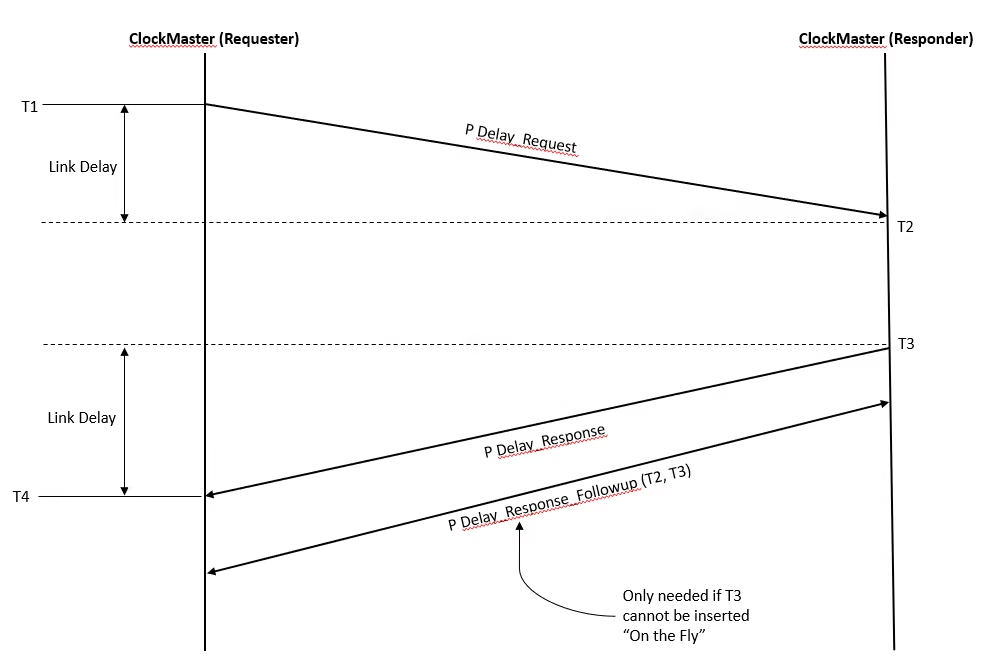
This approach enables highly accurate synchronization, typically achieving around 500 nanoseconds across 7 hops when using 100 ppm oscillators, which is sufficient for tightly synchronized applications such as multi-channel audio playback or synchronized camera systems in automotive and professional AV environments.
SRP (Stream Reservation Protocol)
The Stream Reservation Protocol (SRP) is used in AVB TSN networks to reserve the necessary bandwidth and resources for time-sensitive data streams. In this process, stream sources are referred to as talkers, while stream sinks are known as listeners.
A talker initiates communication by sending a stream advertisement that describes the stream’s requirements, such as bandwidth and timing constraints. AVB-capable bridges (switches) examine these advertisements to check whether they have sufficient resources available. If adequate capacity exists, the bridges reserve the required resources and forward the advertisement to their other ports.
As the advertisement moves through the network, latency is measured at each hop and accumulated along the path.
This process continues until the listeners are reached. Once reached, the listeners are aware of the stream’s requirements as well as the total end-to-end latency back to the talker.
For SRP to function correctly, every device along the communication path must be AVB-capable.
FQTSS (Forwarding & Queuing for Time-Sensitive Streams)
Forwarding and Queuing for Time-Sensitive Streams (FQTSS) defines how time-sensitive data is handled within an AVB network to ensure predictable and reliable delivery. It uses Traffic Shaping to distribute packets evenly over time, preventing packet “clumping” that could block or delay other network traffic and ensuring a smooth, controlled flow of data.
Within an AVB endpoint, streams that have reserved resources are given higher priority for transmission compared to best-effort traffic.
This prioritization ensures that time-critical audio or video streams meet their latency and quality requirements, even when the network is carrying additional non-time-sensitive data.
Network with AVB TSN and non-AVB Segments
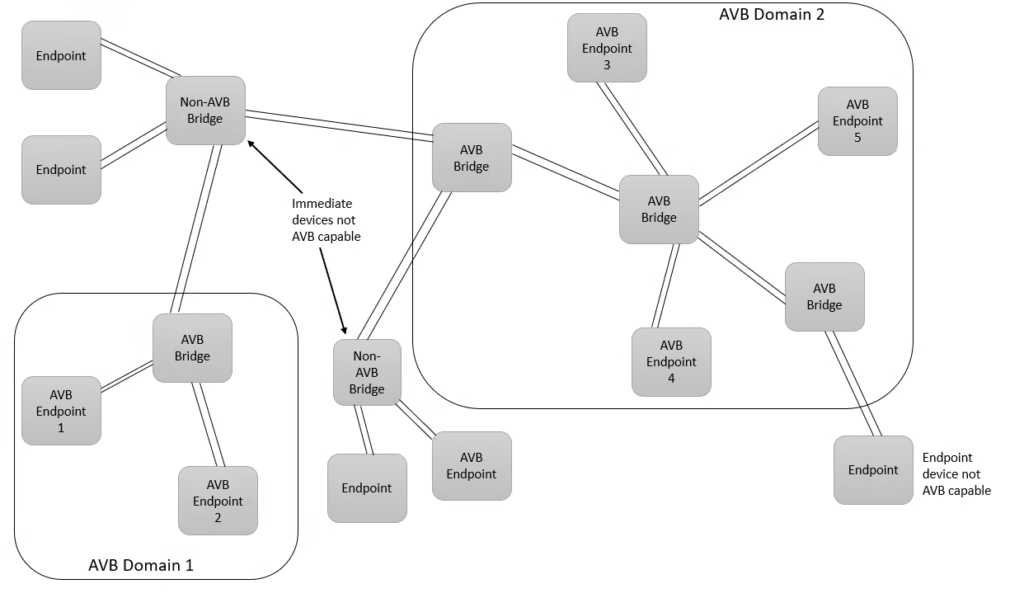
Professional quality A/V is not possible between AVB endpoints 1 and 3 since there are non-AVB links in the path between the two. Professional quality A/V is only possible between devices in the AVB cloud.
AVB switches uses a credit-based shaper algorithm to send AVB packets smoothly.
- Credit for an AVB class is accumulated over time.
- Credit “spent” when a pocket is transmitted.
- Frames are only sent if the credit is zero or positive.
- Enforces fairness by guaranteeing that a certain percentage of conventional traffic is transmitted.

